FOLDING: VARGAS-SUAREZ UNIVERSAL & EDUARDO E. PORTILLO: OPENING FRIDAY APRIL 24, 2026 6-8:30PM

|
Barbara Davis Gallery is pleased to present Folding, an exhibition bringing together the work of Vargas-Suarez Universal and Eduardo E. Portillo: two artists who approach abstraction as an intensely human form of navigation. Whether grounded in earthly landscapes or reaching out to the cosmos, both of their works unfold like maps—guiding the viewer through complex terrains of knowledge, memory, science, and place.
The exhibition opens Friday, April 24, 2025, from 6:00 to 8:30 pm and will be on view through June 20, 2026. |
|
At the conceptual center of this exhibition is the orbifold, a structure that describes the space formed through folding, compression, and transformation of dimensions. Through their distinct practices, the two artists connect at this idea of the orbifold: a way to imagine landscapes, technologies, and histories as overlapping systems folded onto one another. |
|
|
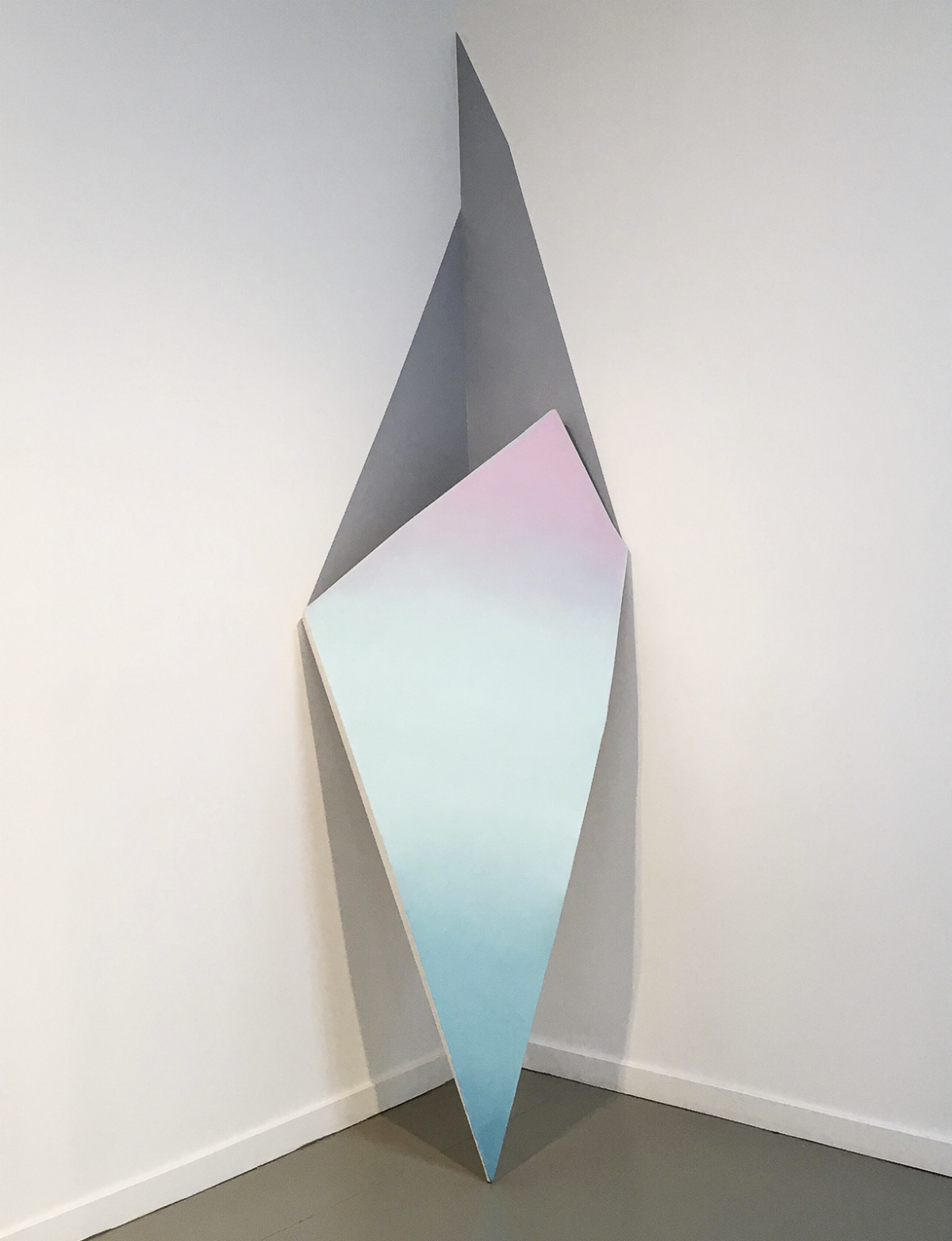
Eduardo E. Portillo Alalik G16, 2026 Acrylic on shaped canvas 82 x 38 inches |
|
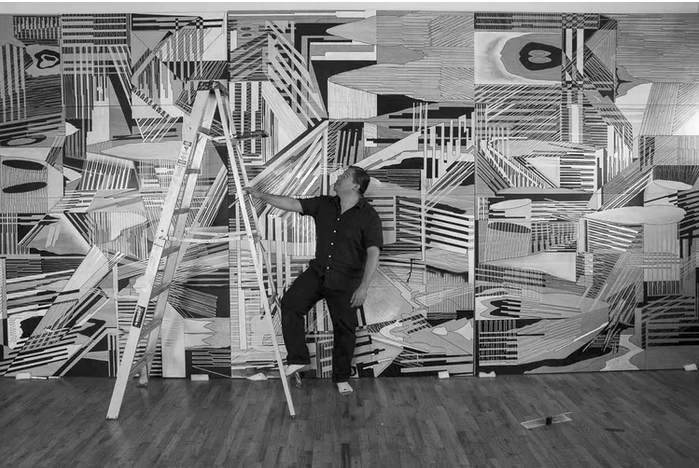
The work of Vargas-Suarez Universal operates at the intersection of art and scientific inquiry. Applying principles akin to the scientific method, his practice unfolds through research, observation, and translation. The resulting artworks—which range from paintings and sculptures to sound works and multimedia installations—draw from a variety of fields including astronomy, engineering, geology, and technological history. His research has taken him to major scientific and aerospace institutions such as the Arecibo Observatory, NASA Ames Research Center, Johnson Space Center, Kennedy Space Center, the Spallation Neutron Source at Oak Ridge National Laboratory, the Gagarin Cosmonaut Training Center, and the Baikonur Cosmodrome. |
|
Vargas-Suarez Universal collects fragments of data, diagrams, and aerospace imagery from these investigations, and through his work translates them into a vivid abstract language of radiant geometries. His compositions mold the analytical precision of science into visual poetry; Lines stretch across surfaces like orbital paths, bursts of color recall solar radiation or cosmic events, structural diagrams unfurl like speculative maps of unseen forces. The resulting works are like celestial cartographies, attempting to render the invisible energies that connect humanity to the technological and cosmic environments we inhabit. |
|
|
If Vargas-Suarez Universal’s work looks outward towards the architecture of the universe, the work of Portillo focuses in on the ground beneath our feet. Born in El Salvador and later relocating to the United States, Portillo’s artistic sensibility has been shaped by his early experience of migration and displacement. His childhood fascination with natural terrain—soil, hills, forests, and rivers—evolved into a deep curiosity about cultural landscapes: environments shaped by memory, architecture, and movement. Migration transforms the familiar world into something suddenly alien; the landscape once known becomes a memory, while new surroundings appear almost planetary in their strangeness.
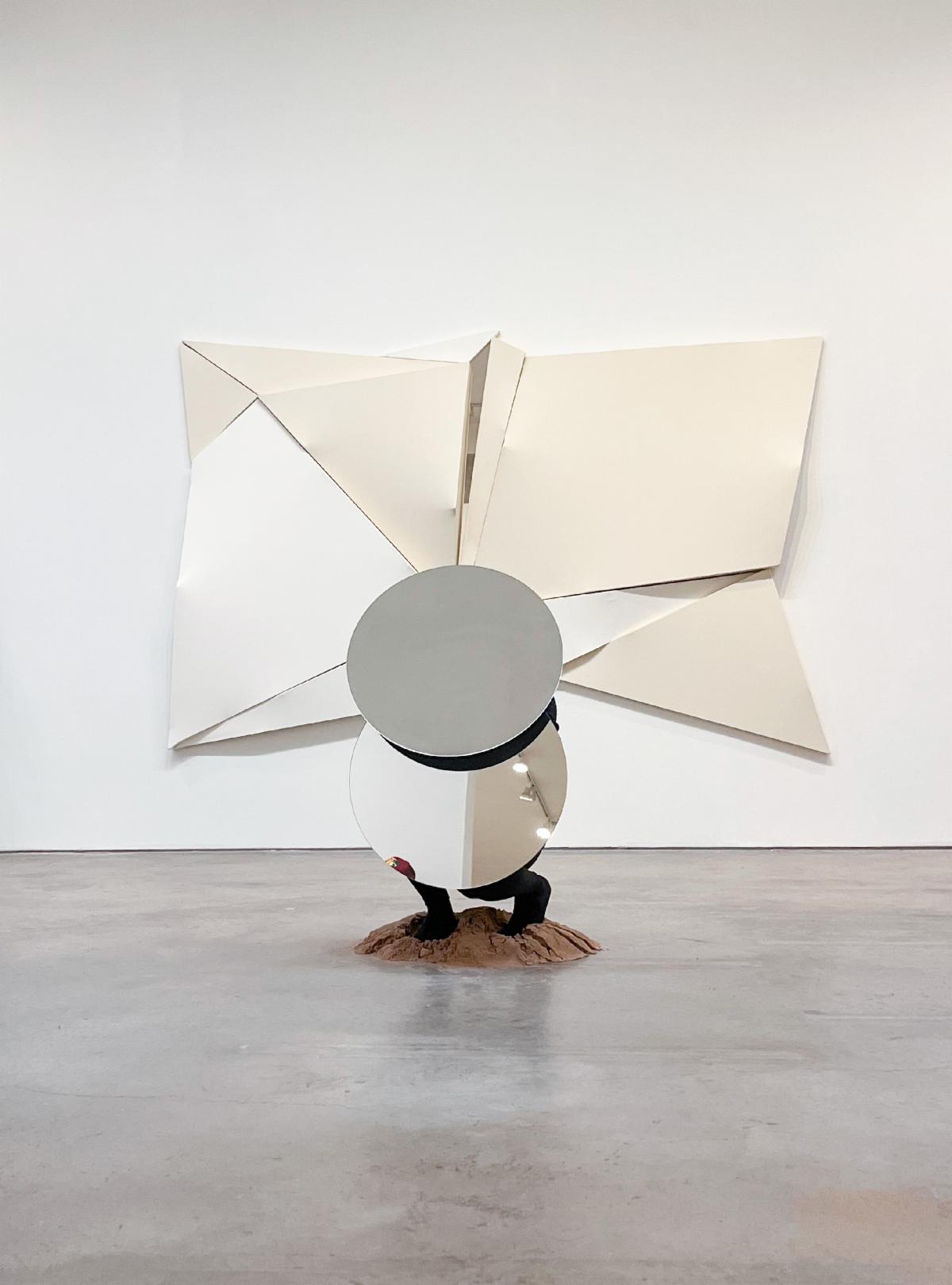
Portillo’s paintings embody this tension between the natural and the constructed. He shapes canvases that extend beyond the traditional rectangle, pushing outward from the wall like fragments of terrain or tectonic plates shifting beneath the Earth’s surface. In color palettes reminiscent of sand, soil, and skin, he constructs interlocking forms whose edges meet with geological precision. These shapes push and pull against one another like landscapes negotiating space—soft organic forms meeting the sharp geometry of architecture. |
|
|
Drawing lies at the conceptual heart of Portillo’s practice. With an emphasis on line and instinct, he effectively draws with space itself. The three-dimensionality of his work invites light to activate the compositions: shadows stretch and bend across the wall, forming living lines that shift throughout the day. The installation becomes a dynamic environment, evolving like a landscape in response to time and weather. In his recent work, Portillo introduces new layers of symbolism by incorporating worldly materials such as mirrors and sand. Sand falls like a freeform hourglass, marking the quiet passage of time. Glass mirrors—formed from sand themselves—reflect the world back onto itself, collapsing the boundary between natural matter and human construction. These materials suggest a cycle of transformation where earth becomes architecture, landscape becomes reflection, and matter becomes memory. |
|
Within the framework of the Orbifold, the works of Vargas-Suarez Universal and Portillo behave as folded dimensions of the same conceptual terrain. Vargas-Suarez Universal charts trajectories through the cosmos with the vectors of technology, space exploration, and scientific discovery; while Portillo charts the complex terrain of migration, landscape, and cultural memory. One artist examining the systems that extend us outward into the universe; the other exploring the systems that shape how we inhabit the earth. Like an orbifold itself, this exhibition reveals how cosmic systems, human histories, environments, and technologies overlap and intertwine. In the folded space between orbit and soil, vector and root, reflection and trajectory, these artworks invite viewers to consider their position within a vast and ever-unfolding structure of space, time, and place. |

